“Feel Lighter. Look Better. Live Stronger.”
“Feel Lighter. Look Better. Live Stronger.”
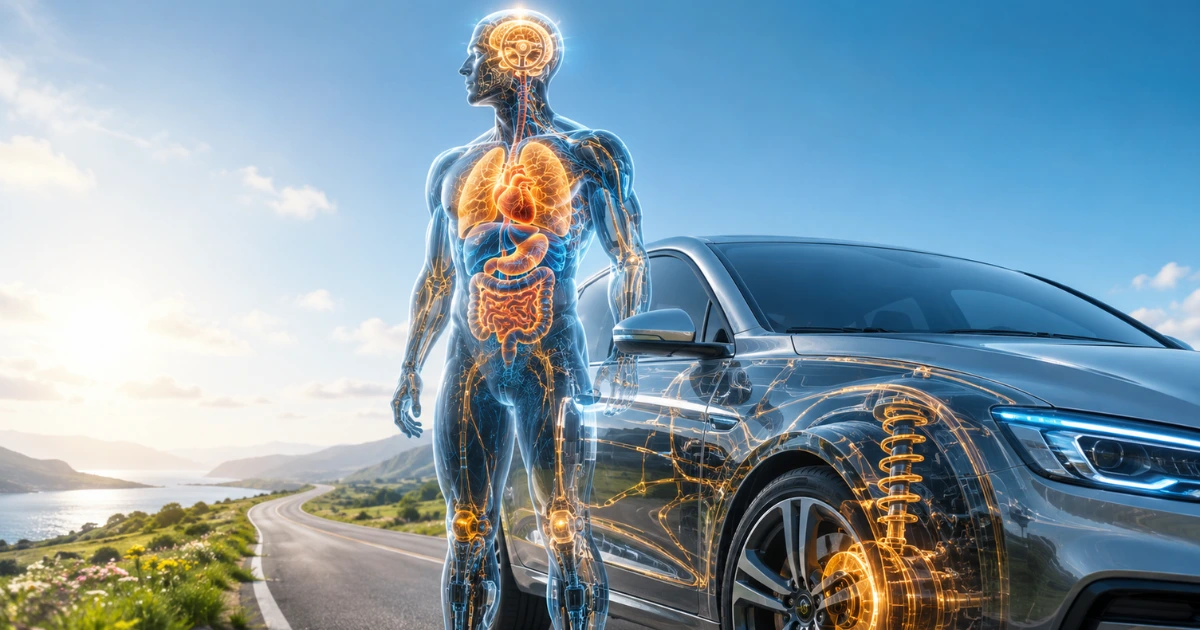
Most people would never dream of driving a car without a manual, yet very few try to understand your body like a car with its own engine, fuel system, and steering. We happily learn how our vehicles work and how to protect them from damage, but we ignore the basic “user guide” for the most important machine we own: our own body.
In this article, we will explore a powerful idea: your body is a human automobile. When you understand its design, its basic needs, and its built‑in guidance system, you can drive it farther, faster, and more safely through life. This is not about becoming a doctor. It is about learning the simple “user manual” that everyone should know to protect their health, happiness, and long‑term success.
If you look at a car engine without training, it may seem full of random pipes, wires, and metal parts. But any good mechanic will tell you that every piece, every tiny screw, has a reason to exist. The human body is the same. There is not an unnecessary part or meaningless “cog” anywhere in the whole system.
It is true that we have a few small remnants that are not as useful as they once were in our evolutionary past, and sometimes they cause trouble. But for the most part, if you take time to look carefully at any organ – the heart, lungs, liver, kidneys, skin, or brain – you can usually figure out what it is meant to do and why it has that particular shape and size. The more you respect this intelligent design, the more you realize that your body is not your enemy. It is a highly organized machine working day and night to keep you alive.
The word “physiology” may sound technical, but the subject itself is surprisingly simple. One reason is that you already know a lot about your body. You have lived in it for years. You have felt hunger, thirst, pain, pleasure, fatigue, and energy. You have been sick, recovered, stayed up late, and slept deeply. Without realizing it, you have been studying your own body your entire life.
When you begin to read or learn about how the body works, this knowledge doesn’t come from nowhere. It connects with experiences you already understand. You suddenly see why you feel heavy after a large meal, why you get cranky when you don’t sleep, and why fresh air wakes you up. Physiology takes what you feel and gives it a clear explanation. That is why studying it can be much easier – and much more interesting – than people expect.
Another reason this “human automobile” is so remarkable is that it comes with its own guidance system: your instincts. Long before you knew any science, your body was already sending signals to help you take care of it.
You know to eat when you are hungry and drink when you are thirsty, even if you do not always know when to stop or what exactly to eat. You prefer sunny days to dark, cloudy ones and fresh air to stale, polluted rooms. On a hot, dusty day you naturally want to go wading or swimming to cool off. When you feel tired, nobody needs to remind you to go to sleep. You would much rather have sugar than vinegar, sweet milk than sour milk, and you dislike eating or drinking anything that looks dirty or smells bad.
These natural likes and dislikes – what we call instincts – are not random. They are the powerful forces that helped build and protect the human body throughout the past. When they are properly understood and trained, they can still be trusted to guide us in the future.
Instincts are a great starting point, but they are not perfect. In the modern world we are surrounded by processed food, artificial light, constant stress, and endless screens. This environment can confuse our natural signals. Sometimes we keep eating long after the hunger signal has been satisfied, or we scroll on our phones when our body is clearly asking for sleep.
The goal, then, is not to ignore your instincts or to obey them blindly. It is to follow them intelligently. That means learning:
This intelligent balance is exactly what basic physiology and hygiene can teach you. They do not replace your instincts; they help you interpret and refine them.
To see this clearly, imagine once more that your body is a car. It has:
Like any car, your body warms up when it runs, and it will eventually stop if it is not fed. Unlike a car, you cannot trade it in for a new model. You only ever get one. That is why it is so important to learn how to steer it, how to maintain it, and how to repair the road when it becomes rough.
You do not need to memorize every muscle and cell. What you do need is a friendly, practical understanding of:
This is what the study of physiology and hygiene really offers you: not dry facts, but a map for a longer, more useful, and more joyful life.
Treat your body as the precious human automobile it is. Listen to its signals, respect its limits, and give it the fuel and maintenance it deserves. When you do, your body will reward you with more energy, clearer thinking, better mood, and a longer, smoother journey through life.